
Priorities blur, judgement degrades, and decisions made in calm conditions do not survive contact with the reality of high-pressured situations.
Strategy falters when pressure distorts execution.
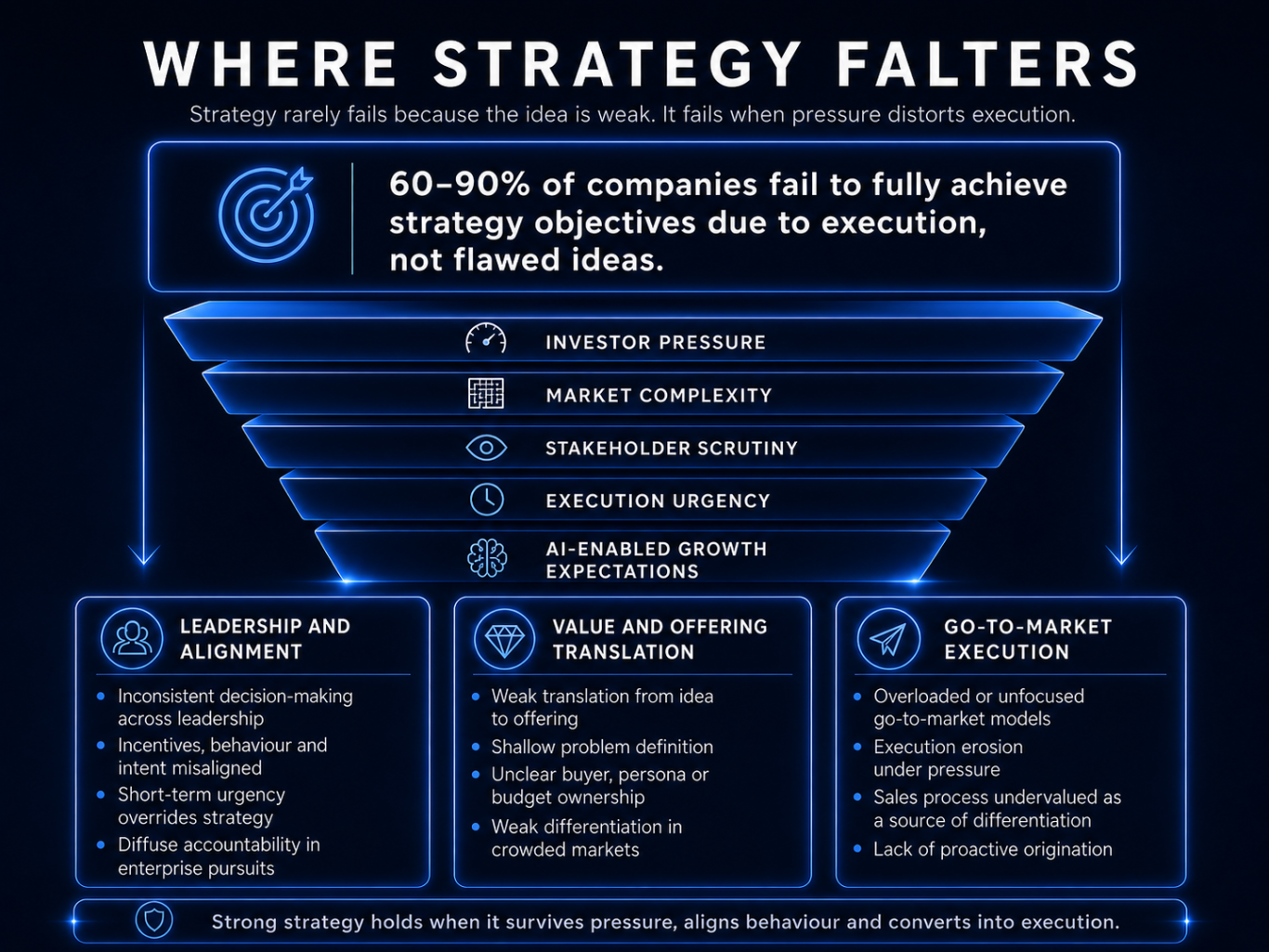
Research shows that 60–90% of companies fail to fully achieve their strategy objectives due to poor execution, not flawed ideas — meaning the majority of growth or sales strategies don’t deliver on their intended outcomes.
Strategy in Times of Transition
This is when judgement, sequencing, and execution under pressure determine outcomes, for instance:
A. Entering a new venture, product, or market
B. Revamping and accelerating growth within an existing business
AI brings an additional dimension to this, where success is assumed to depend on how quickly a business can innovate and adapt.
These are the prime situations for embedding the logic of Awareness → Presence → Discipline™.
Awareness orients you to the market.
Presence determines whether the market lets you in.
Discipline determines whether growth compounds.
Understanding the system — and being understood by it
Awareness
Awareness is about orientation. It is the ability to see the terrain clearly — externally and internally — and to position the business credibly within it.
In enterprise sales strategy, awareness includes both understanding the market and making the market aware of the business in a way that is relevant, timely, and credible.
Awareness involves:
Externally
- Market and sector dynamics
- Competitive landscape and sources of differentiation
- Target customers, accounts, and organisational complexity
- The client problem to be solved and its true materiality
- Timing, budget cycles, and decision context
Internally
- Assumptions held by leadership and sales teams
- Sales capabilities, incentives, and team structure
- Organisational readiness to enter, expand, or accelerate
Contextual emphasis:
- New venture or market: building market awareness while validating demand and problem relevance
- Existing business: sharpening focus, correcting assumptions, and re-aligning effort around where growth is genuinely available
Impact is Connection — credible, relevant engagement with the right buyers, at the right time, around the right problem.

Engaging the customer without distortion
Presence
Presence is about contact, not analysis.
It is the ability to engage the customer without agenda, projection, or inherited narrative — and to meet what is actually happening, rather than what the sales process expects.
Presence involves:
- Listening without filtering through past experience, ambition, or internal pressure
- Suspending assumptions and premature solutioning
- Developing an undistorted view of the customer’s problem, constraints, and reality
- Being fully present in the customer’s world, not merely running a sales process
Contextual emphasis:
- New venture or market: deep immersion to understand how the problem is genuinely experienced
- Existing business: re-seeing familiar customers clearly, rather than through legacy relationships or outdated positioning
Impact is Trust — which emerges when the customer feels accurately understood, not managed or persuaded.

Executing with coherence and process
Discipline
Discipline is the translation of awareness and presence into consistent execution across the enterprise sales journey.
It is where strategy becomes observable, repeatable action.
Discipline involves:
- Clear progression through a sales journey
- A deliberate balance between:
- Sales as an art (judgement, narrative, timing)
- Sales as a science (process, data, governance, repeatability)
- A clear philosophy of selling the problem the business is best placed to solve
- Sustaining execution quality as pressure, scrutiny, and consequence increase
Contextual emphasis:
- New venture or market: learning loops, proof points, and establishing repeatability
- Existing business: improving conversion, momentum, and scale under pressure
Outcome is a Compelling Value Proposition, reinforced not just by what is sold, but by how the sale itself is conducted.