

A Series of Reflections
Proprietary reflections on work, performance, pressure, and the moments that shape us, written from deep experience rather than opinion.
These essays explore how pressure moves through organisations and ultimately shapes enterprise sales performance.
My Proprietary Frameworks:
Spirals of Growth and Pressure™
Lag Between Behaviour and Performance™
Pressure–Presence–Trust Model™
Awareness → Presence → Discipline™
Section 1
System Dynamics of Growth and Pressure
These explain the environment and mechanics of performance.
1) Growth Under Pressure: The Investor’s Real Challenge
2) Enterprise Sales in the Spirals of Growth and Pressure™
3) How Pressure Shapes Performance
Section 2
Operating Inside Pressure
These explain how people behave and perform within that system.
5) Awareness → Presence → Discipline™: The Architecture of Growth Under Pressure

1) Growth Under Pressure: The Investor’s Real Challenge
Investors have visibility.
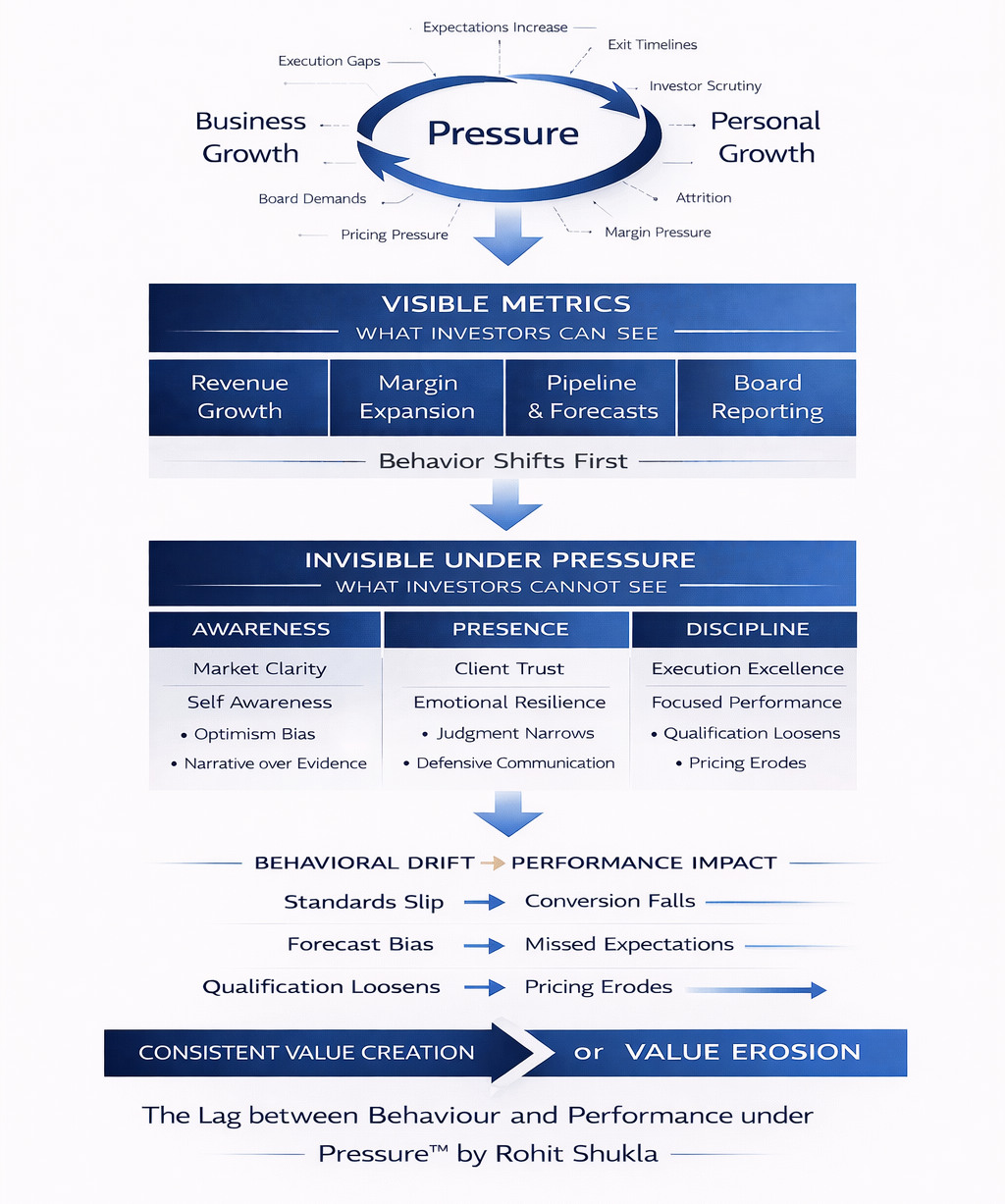
They can see revenue growth and margin expansion. They can analyse pipeline coverage, cash conversion, customer concentration and forecast accuracy. They can interrogate board packs, test assumptions and benchmark performance across a portfolio. Financial, commercial and operational data is available in increasingly sophisticated forms.
They can see the outputs. What they cannot directly see is how pressure is moving through the organisation that produces those outputs.
And it is pressure that ultimately determines whether growth compounds or fragments.
In stable conditions, reporting systems function well. There is an implicit trust between investor and management. Forecasts are assumed to reflect genuine conviction. Pipeline narratives are believed to be grounded in disciplined qualification. Strategic plans are treated as coherent expressions of intent rather than aspirational storytelling. Often, that trust is justified. In stable environments, capability and performance tend to align.
However, when expectations increase, the internal physics of the organisation change.
Pressure enters through leverage, valuation targets, compressed exit timelines, macro deterioration, competitive disruption or heightened board scrutiny. When expectations rise, behaviour shifts before performance does. The organisation begins to respond to scrutiny long before the numbers visibly deteriorate.
That behavioural shift rarely appears in dashboards.
Due Diligence Is Necessary. It Is Not Sufficient
Private equity firms deploy significant rigour at entry. Financial diligence tests earnings quality and cash resilience. Commercial diligence assesses market attractiveness and competitive positioning. Operational diligence evaluates systems, processes and leadership capability. The process is structured, disciplined and increasingly data driven. It is indispensable.
Yet due diligence is primarily retrospective and structural. It evaluates what has happened, what exists today and whether projections appear credible under current assumptions. It is designed to answer whether a business is investable, scalable and defensible in its present form.
What it cannot fully evaluate is how the organisation will behave when pressure materially increases after investment.
Post investment, the context changes. Growth targets harden. Leverage introduces urgency. Incentives sharpen. Exit narratives begin to form earlier than many acknowledge. The tone of scrutiny becomes more explicit.
Under those conditions, the internal behavioural equilibrium shifts.
Due diligence cannot easily detect whether qualification standards will quietly loosen when targets are missed. It cannot fully anticipate whether pricing discipline will erode to defend momentum. It cannot predict whether forecast confidence will gradually become narrative driven rather than evidence based. It cannot model whether leaders will narrow debate under scrutiny, reducing internal challenge in favour of alignment.
These are not technical failures.
They are human responses to pressure.
And they tend to surface slowly, often invisibly, until they reach the numbers.
The paradox is clear. A business can pass rigorous due diligence with strong fundamentals and capable leadership, yet still experience value erosion if behavioural integrity fragments once expectations intensify.
What Pressure Actually Changes
Pressure does not create weakness out of nothing. It applies force to what is already present.
In some organisations, increased expectations sharpen focus. Leaders slow down rather than speed up. Decision making becomes more deliberate. Qualification standards tighten. Pricing discipline strengthens. Communication becomes clearer. In these systems, pressure acts as a performance amplifier.
In others, pressure narrows perception. Time horizons compress. Urgency replaces judgement. Pipeline definitions expand. Optimism becomes more forceful. Teams begin to prioritise visible activity over structural quality. Forecasts smooth. Risk tolerance shifts in subtle but compounding ways.
Both organisations may initially report similar numbers.
The divergence emerges later.
Under pressure, organisations drift toward one of two consistent states. Either clarity, composure and disciplined execution strengthen across leadership layers. Or defensiveness, short term optics and quiet window dressing begin to spread.
The investor typically sees the outputs of this shift only after it has already taken hold.
The Limits of Visible Metrics
Investors rightfully rely on metrics. Revenue growth, margin resilience and forecast accuracy are critical signals. However, metrics are lagging indicators of behavioural consistency.
By the time conversion rates decline, standards may have been drifting for quarters. By the time pricing compresses, negotiation discipline may already have weakened. By the time forecasts miss, internal debate may have narrowed significantly.
Visible performance can remain stable while invisible discipline erodes.
This is why implicit trust, while necessary, becomes insufficient in pressured environments. Not because management lacks integrity, but because pressure distorts perception in ways that are often unconscious.
Judgement narrows under scrutiny. Risk feels heavier. Short term performance feels existential. Leaders can begin to protect valuation before they protect structure, not through manipulation but through subtle prioritisation shifts.
The system tilts.
The Real Variable: Consistency of Mindset Under Pressure
Sustainable value creation in pressured environments depends less on capability and more on consistency.
- Awareness determines whether the organisation continues to see the market clearly rather than through the filter of hope or defensive optimism.
- Presence determines whether leaders remain composed and deliberate when stakes increase, or whether urgency contaminates judgement.
- Discipline determines whether execution standards hold firm when shortcuts become tempting.
When these conditions are consistent across leadership layers, pressure sharpens performance and value compounds. When they fragment, pressure gradually undermines what the investor believed they had bought.
The investor’s real challenge is not merely to validate structure at entry, nor simply to monitor metrics post investment.
It is to understand whether the internal system remains coherent as pressure rises.
Numbers reveal outcomes.
Pressure reveals truth.

2) Enterprise Sales in the Spirals of Growth and Pressure™
At senior levels, enterprise sales strategy and performance rarely fail because of a lack of capability. Most leaders I work with are experienced. They have commercial judgement. They understand markets. They carry ambition. They know how to sell.
This means that the issue is rarely competence.
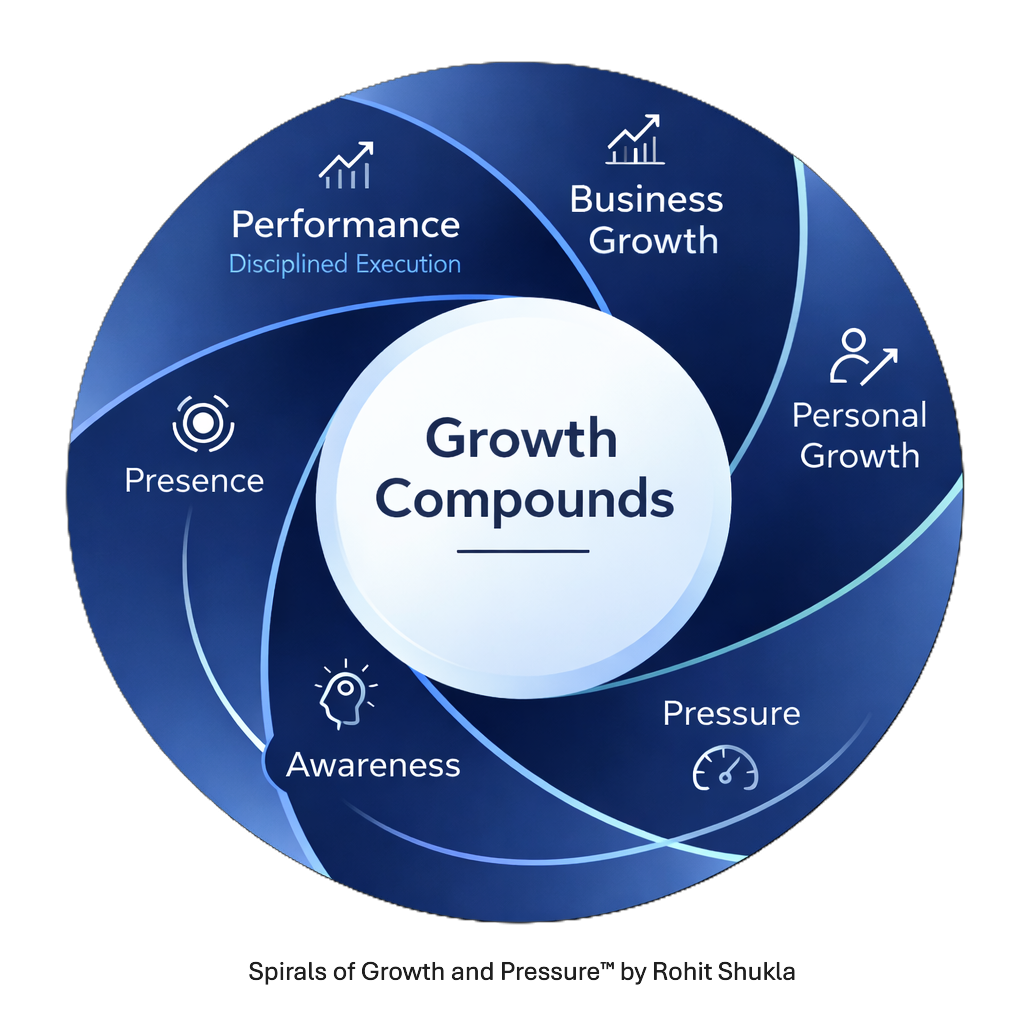
The gap lies in understanding how pressure shapes growth within the Spirals of Growth and Pressure™. Pressure is not episodic. It is structural. It accompanies ambition. It accompanies scrutiny. It accompanies transformation. The moment an organisation seeks accelerated growth, market entry, repositioning, or executive visibility, pressure is present.
Moreover, pressure does not create strength or weakness from nothing. It applies force to what is already present. To strategy. To prioritisation. To judgement. To execution. Under that force, systems either hold or they fracture.
In stable conditions, plans appear coherent. Pipelines appear healthy. Judgement appears balanced. Teams appear aligned. Stability, however, can conceal structural weakness.
Within the Spirals framework, this is the calm phase where fragility often hides inside apparent performance.
Under pressure, perception narrows. Process loosens. Decision making becomes reactive. Priorities drift toward urgency rather than importance. Leaders compensate with activity rather than clarity. This is the inflection point in the spiral.
Growth either strengthens or destabilises.
Growth is shaped by pressure. Performance reveals whether that growth is disciplined or fragile.
Performance makes visible whether results are grounded in sound positioning and structured execution, or whether they were dependent on favourable conditions.
Understanding this distinction changes how one approaches enterprise sales. It shifts the focus from outcomes alone to the internal conditions that produce those outcomes.
The Stabilising Pillars Within the Spiral
Sustainable performance rests on three stabilising pillars inside the Spirals of Growth and Pressure™.
Awareness. Presence. Discipline.
These are not abstract qualities. They are operating conditions.
- Awareness orients a leader to the market. It clarifies where to play and why. It sharpens competitive positioning. It distinguishes signal from noise. Without awareness, teams pursue opportunity rather than advantage. They expand effort rather than precision.
- Presence determines whether the market responds. It is the ability to remain composed under scrutiny. To listen accurately. To negotiate without distortion. To hold clarity when pressure rises. In enterprise environments, presence shapes trust at senior levels. Without presence, strategy may be correct but access weakens.
- Discipline sustains execution under force. It is structured prioritisation. It is deal logic that holds when challenged. It is process integrity when scrutiny intensifies. Discipline prevents strategy from dissolving into improvisation when results are questioned.
When awareness, presence and discipline are strong, pressure refines performance. When they weaken, pressure fragments it.
This is the movement within the spiral. Either upward through strengthened coherence, or downward through accumulated distortion.
Pressure as Diagnostic Within the Spiral
Pressure should not be viewed as the enemy of growth. It is diagnostic.
It reveals whether positioning is precise or aspirational. Whether revenue generation is systemised or personality dependent. Whether prioritisation is strategic or reactive. Whether leadership remains coherent when challenged.
Importantly, business growth and personal growth are interdependent within the spiral. Under pressure, both are tested simultaneously. Enterprise sales environments make this visible because ambition and scrutiny coexist in the same moment. The external spiral of business growth interacts constantly with the internal spiral of personal stability.
If internal coherence weakens, external growth destabilises.
If internal coherence strengthens, external growth compounds.
Growth Compounds Under Pressure
Therefore, I do not see enterprise sales purely as a commercial function. I see it as a system operating under pressure within the Spirals of Growth and Pressure™.
The work is therefore not only about accelerating revenue. It is about strengthening the foundations that allow growth to endure as scrutiny increases. This means, clarity of positioning. Discipline of execution. Sound decision making at critical moments.
Growth is not proven in calm conditions. It is proven under pressure. And within the spiral, pressure is always present.

3) How Pressure Shapes Performance
If you imagine enterprise sales performance as a formula, it may look something like this:
RE + IP + CP + T + V = SP
RE: Right executive
IP: Identified problem
CP: Compelling proposition
T: Timing
V: Value
SP: Sales performance
Even in stable conditions, this equation is difficult to execute consistently. Alignment rarely happens perfectly. Access is partial. Timing is imperfect. Value is contested.
That is before pressure enters the system.
When pressure is introduced, performance does not remain neutral. It diverges. It tilts either upward or downward. And that divergence occurs through the medium of growth.
Where Pressure Comes From
Pressure typically enters through a change in expectations.
A publicly listed growth business comes under heightened investor scrutiny.
A venture backed startup faces compressed timelines to prove traction.
A newly appointed CEO carries the implicit expectation of transformation.
Expectations shift. Pressure rises.
Pressure has energy. It seeks release. It moves from team to team, from leader to manager, from manager to individual contributor. It travels through the organisation in waves. In stable environments, those waves are absorbed. In unstable ones, they amplify.
When Foundations Hold
Pressure can be constructive. It can stretch capability. It can sharpen focus. It can elevate ambition. The question is twofold:
- Are the foundations strong enough to absorb the pressure?
- Is there sufficient capacity to grow in response to it?
A tall tree does not resist the wind rigidly. It sways. It flexes. It remains rooted. In enterprise sales, strong foundations mean disciplined process, clear prioritisation, executive access strategy, internal alignment, and emotional steadiness under scrutiny. When those conditions are present, pressure strengthens performance.
When Foundations Crack
More often, the foundations are thinner than they appear. When pressure cannot be absorbed, it morphs into stress and fear.
What becomes visible:
- Reactive patchwork replaces measured response.
- Decisions accelerate without clarity.
- Process discipline weakens.
- Selective deals are reframed as strategic choice.
- Internal blame surfaces.
- Loyalty softens.
- Leadership focuses on narrative management rather than structural correction.
What remains invisible
- Negative internal dialogue.
- Narrowed perception.
- Avoidance of difficult conversations.
- Low confidence masked as overcompensation.
- Action driven by the need for psychological relief rather than strategic clarity.
This is where enterprise sales performance tilts downward.
The Leadership Question
How can leaders manage this dynamic?
How can they stabilise their own pressure, let alone the pressure moving through their teams?
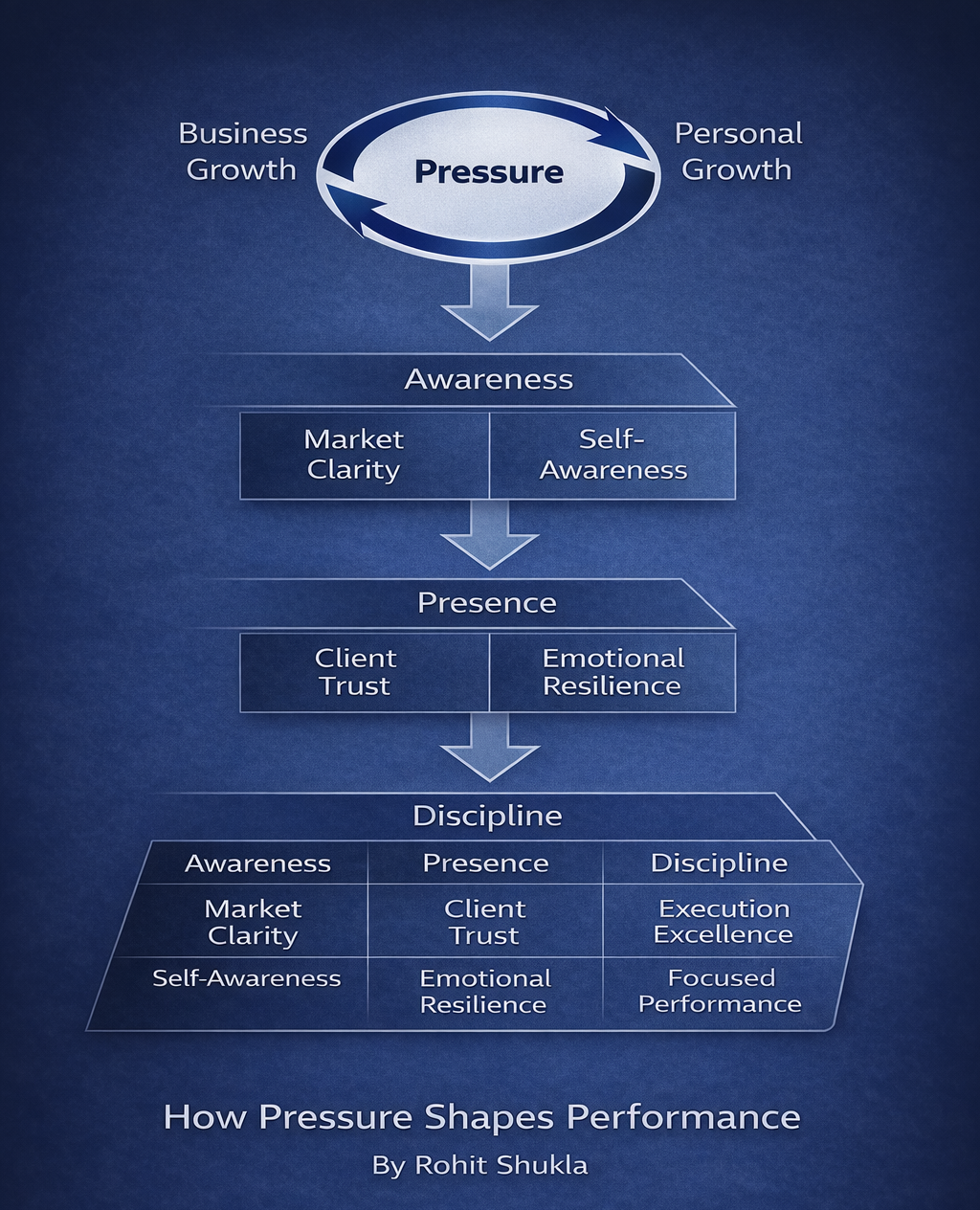
This is precisely why Awareness, Presence and Discipline™ sit at the centre of high pressure enterprise sales environments.
- Awareness stabilises perception.
- Presence stabilises behaviour.
- Discipline stabilises execution.
When those anchors hold, pressure strengthens growth. When they weaken, growth fragments. Pressure does not create strength or weakness from nothing. It reveals what is already there and amplifies it.
That is how pressure shapes performance.

4) The Deal is the Problem
Most enterprise sales conversations appear to involve two people. In reality, there are usually four in the room.
The seller.
The buyer.
And the pressure each of them brings into the conversation.
Enterprise sales conversations often appear straightforward on the surface. A seller meets a buyer to discuss a problem, a capability, or a potential opportunity. Questions are asked, capabilities are presented and possible solutions are explored. The interaction appears to be a rational discussion between two professionals attempting to determine whether a commercial relationship might exist.
Yet what appears to be a simple interaction between two people is often shaped by hidden pressures on both sides. The dynamic is illustrated through my Pressure–Presence–Trust Model™, which explains how enterprise sales conversations move from surface distortion towards authentic opportunity. The blue circles represent the authentic self of both buyer and seller, free from the ego, roles, and defensive masks that pressure often creates.
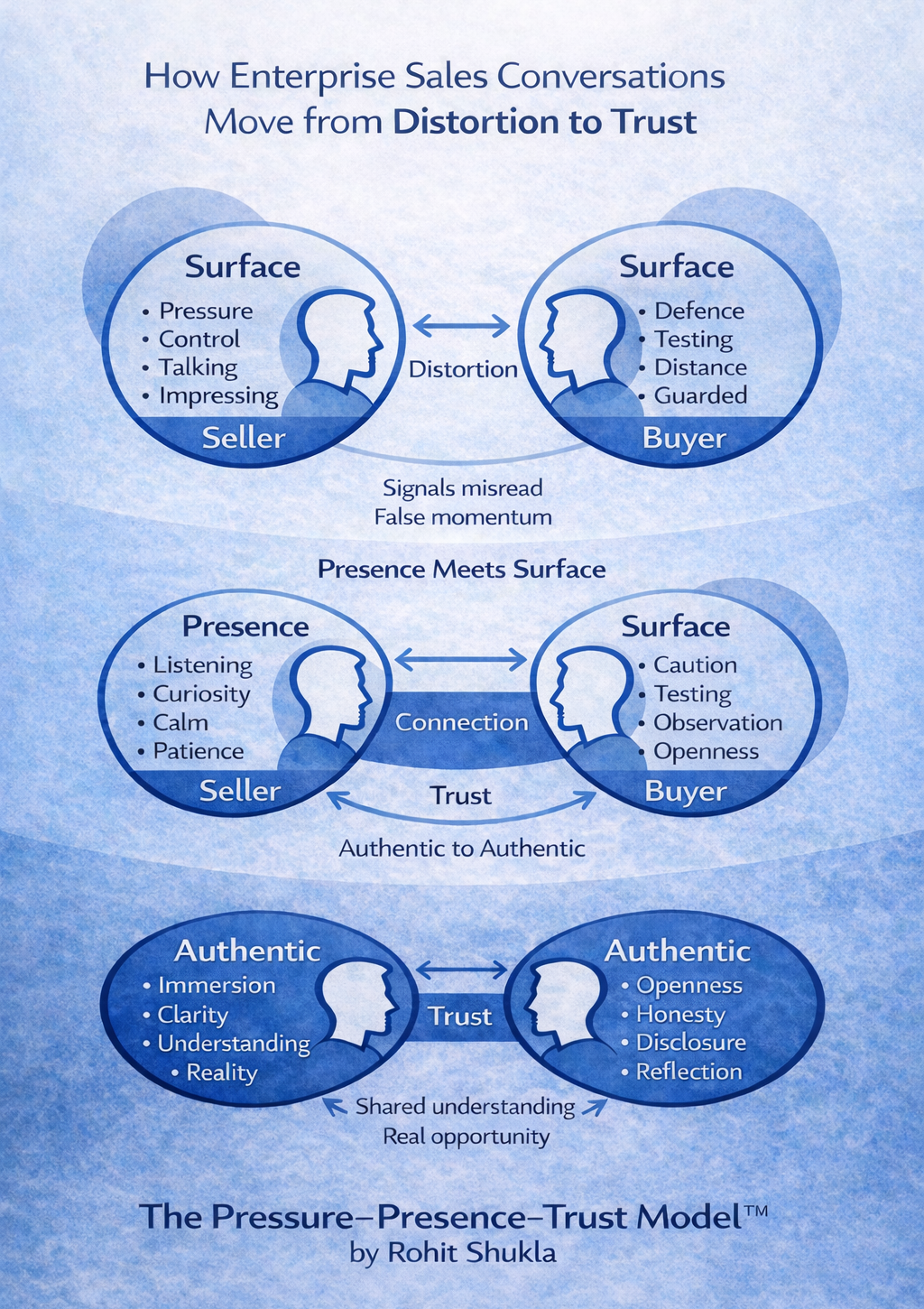
In enterprise sales environments, most conversations are shaped by the pressures that both individuals carry into the interaction. Those pressures often obscure the authentic self. They act as a filter that influences how each person listens and speaks, what they choose to reveal and how they interpret what the other person says.
In that sense, there are often four participants present in the conversation, not two. There is the seller and the buyer who appear to be speaking. But behind each of them sits another presence: the pressure they are carrying into the room.
As a result, the conversation is rarely as objective and true as it appears on the surface. The seller typically enters the discussion with the deal in mind, while the buyer enters with risk in mind. One is oriented toward opportunity, the other toward consequence.
When these two forms of pressure meet, distortion often emerges.
This manifests as signals misread, interest mistaken for intent, deal momentum where none actually exists. Sales pipelines quietly fill with opportunities that feel promising but never progress. This is the reality.
The problem is not always capability, messaging or activity. Very often the issue is not that the deal has entered the conversation too early. The issue is that the deal itself has become the dominant presence in the room. Once that happens, the deal becomes the filter through which the conversation is interpreted. When that happens, distortion begins to shape how both sides listen, respond and make judgements.
The Hidden Dynamic in Enterprise Sales
Salespeople are trained to think about progression. Most sales methodologies encourage sellers to move the opportunity forward, to create momentum, and to guide the buyer toward a decision.
These instincts are understandable. Sales organisations operate under constant pressure to produce results. Revenue targets, forecast expectations, and pipeline reviews all reinforce the need for forward movement through key steps in a sales process.
Yet the moment a seller becomes attached to advancing the deal, something subtle begins to change in the interaction. Questions become slightly more selective. Listening becomes more strategic rather than fully open. The seller begins to shape the conversation in ways that encourage progress rather than real understanding. This shift rarely happens consciously. It is simply the natural consequence of operating under pressure.
At the same time, the buyer is also navigating pressure. Enterprise buyers must consider financial implications, internal politics, operational risk, and personal accountability. Any decision they make may affect budgets, teams, reputations, and careers.
So while the seller is thinking about progressing the opportunity, the buyer is often thinking about protecting their position. This combination of pressures creates a very particular type of interaction. Both parties become cautious. Both interpret signals carefully. Both reveal only part of their thinking. What emerges is a conversation between two surface identities rather than two authentic individuals.
Surface to Surface
At the surface level of a conversation, behaviour tends to become protective and controlled.
The seller surface often reveals itself through behaviours such as pressure to progress the opportunity, attempts to impress the buyer with expertise, or a tendency to talk more than listen. There may also be a subtle effort to guide the discussion toward the seller's preferred outcome. From the seller's perspective, these behaviours can feel entirely reasonable. After all, the objective of the meeting is to explore whether a deal exists.
From the buyer's perspective, however, these signals can create distance. The buyer surface often responds through caution and guarded engagement. The buyer may test the seller's credibility, offer partial information, or maintain a degree of emotional distance while they assess the situation.
Neither party is fully relaxed in the conversation, both are evaluating the other, and both are protecting something. Under these conditions, distortion becomes almost inevitable.
This means that a polite response may be interpreted as interest, a thoughtful question may be interpreted as buying intent and a willingness to continue the conversation may be interpreted as progress toward a deal. In reality, the buyer may simply be gathering information while remaining uncertain about whether a meaningful problem exists. In other cases, they may simply be avoiding the discomfort of saying no.
Many sales conversations remain at this level.
The Role of Presence
What changes the dynamic is presence. Presence is the ability of the seller to remain calm, attentive and genuinely curious without becoming attached to the outcome of the conversation.
Instead of trying to move the deal forward, the seller becomes immersed in understanding the buyer’s world. Attention shifts away from managing the opportunity and toward observing the situation as it actually is.
The seller listens carefully, without a filter, to what is being said and, just as importantly, to what is not yet being said. Subtle signals become clearer. Assumptions begin to soften. The conversation slows down and becomes more real.
Presence Meets Surface
At this stage, the seller is operating from presence while the buyer may still be operating from the surface. The seller’s behaviour is characterised by listening, curiosity, patience and calm attention. There is no longer a need to impress or persuade. Instead, the focus shifts to understanding the situation as clearly as possible without a predetermined outcome.
The buyer may still be cautious, be testing, and observing carefully before revealing deeper concerns. However, something important begins to emerge.
Connection.
The buyer begins to sense that the seller is genuinely interested in the situation rather than simply trying to close a deal. This perception allows trust to begin forming. The conversation becomes more open. Information that previously remained hidden begins to surface. The buyer may begin to describe internal pressures, organisational constraints, or strategic concerns that had not been mentioned earlier in the interaction.
This stage is often where the true nature of the problem starts to become visible.
Authentic to Authentic
If presence is sustained long enough, the conversation eventually moves into a deeper level of interaction. Both parties begin to engage more authentically.
The seller becomes fully immersed in the buyer's environment, thinking carefully about the pressures shaping the organisation's decisions and priorities. The seller's focus shifts away from selling and toward understanding the broader context.
At the same time, the buyer begins to speak more openly about the realities they are navigating. Concerns that may have remained unspoken earlier in the conversation are now expressed more directly. The buyer may share the internal dynamics surrounding the decision, the risks involved, or the uncertainty that exists inside the organisation.
At this stage, the conversation changes character. It is no longer primarily about evaluating a product or service. Instead, it becomes a shared exploration of a problem.
Trust is now present in the interaction. Understanding begins to deepen on both sides. The seller and buyer begin to see the situation through a similar lens. Only at this point does a genuine opportunity start to take shape.
Why the Deal is the Problem
Many enterprise sales conversations never reach this stage. They remain trapped at the surface level. The seller continues attempting to advance the opportunity while the buyer continues protecting their position. Each side interprets the conversation through their own pressure and assumptions. The interaction appears productive, yet very little of substance is revealed.
The deal becomes the centre of attention rather than the pressure the buyer is trying to resolve. Ironically, when the seller stops focusing on the deal, the conditions for a real deal to emerge finally appear.
The Pressure–Presence–Trust Model™
This progression can be understood through the Pressure–Presence–Trust Model™, which explains how enterprise sales conversations move from distortion towards authentic opportunity.
Pressure creates surface behaviour and defensive interactions. Presence stabilises the conversation and allows connection to form. Trust enables authentic dialogue and reveals the real problem that may need solving.
The paradox is simple.
The less the seller focuses on closing the deal, the more clearly the conditions for a real deal begin to emerge.

5) Awareness → Presence → Discipline™: The Architecture of Growth Under Pressure
If pressure is the defining variable, then structure becomes decisive.
The framework of Awareness → Presence → Discipline™ is the architecture that absorbs pressure in enterprise sales environments. Each element stabilises the one that follows. Remove one, and the system weakens under force.
To recap, pressure does not wait for clarity. It compresses time, narrows perception and amplifies consequence. In enterprise sales environments, ambition and scrutiny coexist continuously. Growth therefore depends not on intensity of effort, but on alignment under pressure.
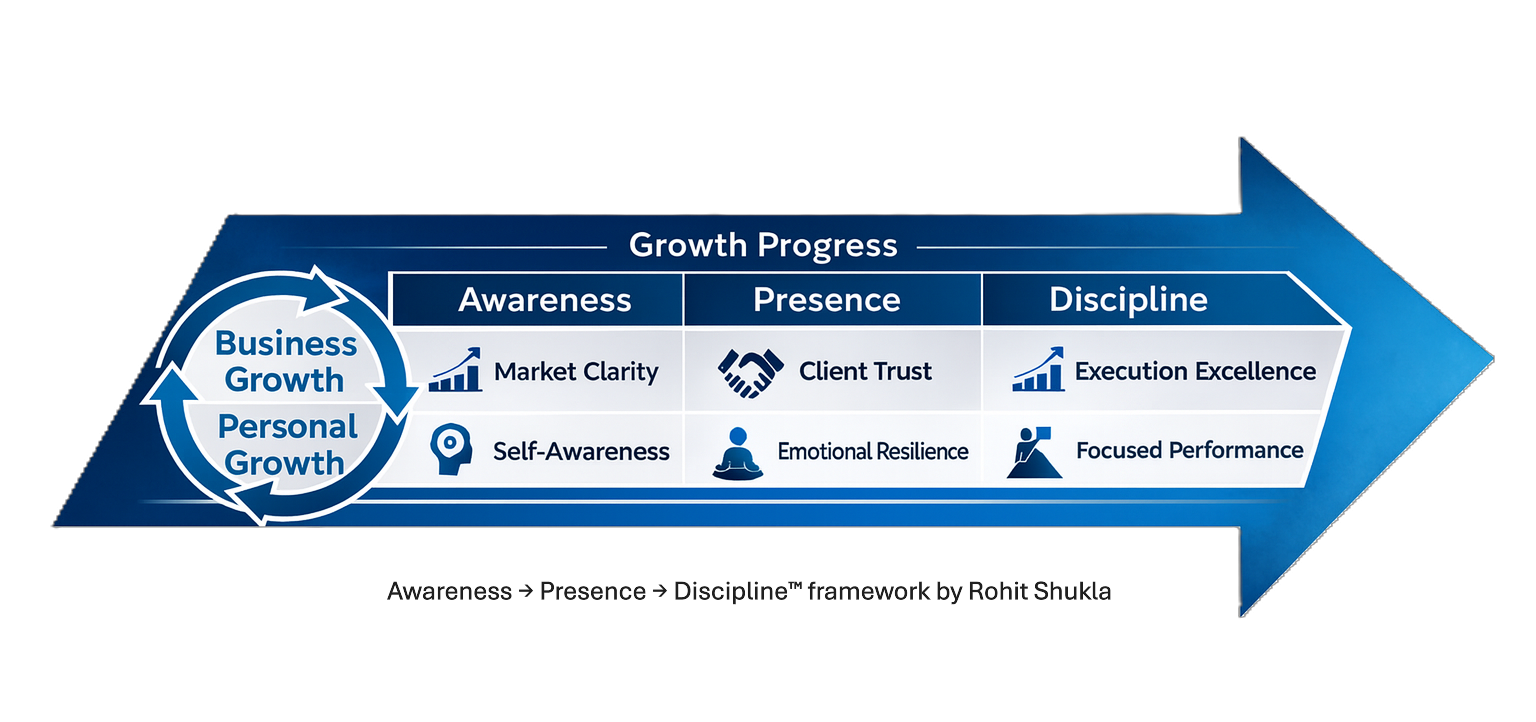
Awareness
Awareness is orientation.
At the business level, it is market clarity such as understanding of where advantage truly lies and where it does not. At the personal level, it is self-awareness through recognising the subtle distortions that pressure introduces into feeling, thought and judgement.
Without orientation, activity increases but direction blurs. For instance, under pressure, teams often mistake movement for progress, pipelines expand while qualification weakens, opportunities are pursued because they are large and not because they are winnable.
Awareness prevents this drift. It holds the line between signal and noise. It shapes qualification standards, resource allocation and the discipline of saying no.
To be clear, awareness does not magically eliminate pressure, but it does allow pressure to be interpreted accurately.
Presence
Presence is alignment.
So, if awareness translates into how leaders and teams observe themselves and the market - without distortion, presence shapes whether the market responds with trust or hesitation.
Client trust is rarely built through value messaging or physical presence alone, it is built through steadiness. At the individual level, presence starts with emotional resilience and nervous system stability. The latter is easily picked up on by other people, whether it's through body language or voice tone and tempo.
Presence is the ability to remain immersed in the client’s world without self-distortion. It is accurate listening without agenda, clarity without urgency, and response without reaction. It's the quality of undivided attention, and resembles the undivided attention of kneeling to listen to a child, or being fully absorbed in a film. It manifests as accurate listening with no preconceived ideas of conditioned interpretations, and leads to improved understanding, connection, and clarity through right response rather than rushed reaction.
Where awareness stabilises perception, presence stabilises interaction.
Discipline
Discipline is endurance.
Under sustained pressure, strategy is tested through execution. Priorities compete. Timelines compress. Stakeholders multiply. Forecasts are interrogated. The temptation is to substitute urgency for precision.
Discipline prevents that substitution. It is execution excellence at the business level through structured prioritisation, coherent deal progression, and process integrity when scrutiny intensifies. It ensures discovery remains rigorous, decision pathways are mapped accurately, and deal logic holds under challenge.
It's not inflexibility when adaptability is required, nor is it stubbornness when direction changes. It's the discipline to follow the formula of success whether that formula evolves or not.
At the personal level, discipline becomes focused performance through sustained effort without volatility. It's the ability to maintain standards even when outcomes are uncertain and results aren't visible.
The reality is that enterprise sales cycles stretch across months or years. The longer the cycle, the greater the temptation to deviate. Discipline keeps growth from becoming fragile. And from a prospect's perspective it shows that the salesperson is consistent in their commitment to the relationship as opposed to only engaging with them when the dollar signs are visible.
Where presence stabilises engagement, discipline stabilises delivery.
Structural Coherence in Enterprise Sales
Enterprise sales environments are structurally pressured systems. Revenue targets are visible. Pipelines are scrutinised. Boards demand acceleration while risk committees demand prudence. Competition intensifies precisely when budgets tighten and there is a need to do more with less.
In that environment, pressure is not episodic. It is constant background force.
- The question is not whether pressure exists.
- The question is what it acts upon.
- If awareness is weak, qualification erodes.
- If presence is weak, trust fractures.
- If discipline is weak, execution deteriorates.
Short-term results may still appear strong. But without coherence, growth becomes dependent on favourable conditions rather than structural resilience.
When Awareness, Presence and Discipline operate together, growth compounds.
When they fragment, performance destabilises.
The framework therefore does not describe growth in calm conditions. It describes growth that holds under pressure. To put it bluntly, this is not a model for when markets are stable, pipelines are predictable, and scrutiny is light. Anyone can look effective when:
- Targets are modest
- Competition is weak
- Budgets are flowing
- Stakeholders are aligned
Calm conditions conceal weakness.
Enterprise sales is not purely a commercial function. It is a system operating under continuous force. Pressure will test the system.
Awareness → Presence → Discipline™ determines whether it holds.
Growth is not proven by expansion alone. It is proven by what holds under force.